
Icarus was an inside job
The Wizards are not good by design and it's bumming me out

There have been fun moments over the past 11 games. Seeing Alex Sarr dunk and then hearing national basketball media talking heads, even ones I don’t like at all, talk about how good he is. Wondering what could possibly be going through Cam Whitmore’s head as he goes iso with 20 seconds on the clock, gets blocked, then does the same thing, in the same way, on the next possession and gets blocked again. Even the low moments feel kind of promising because they seem like an improvement over last season. These fun moments are true and not at all right.
The 2025-26 Washington Wizards can very easily seem like a basketball team. You’d be forgiven for noting that they play the game two-to-three times a week and conclude that this defines them as such. While watching Tre Johnson sprint down the court for a textbook-form catch-and-shoot three, it’s easy to forget that the Wizards are less a basketball team and more a way to transfer risk from today to tomorrow. A medium-term bond or collateralized debt obligation that averages around 18 turnovers a game. And if you’re reading this, I assume you know that this is all by design.
It is worth reiterating that they need to be a bottom four team this season in order to keep their first round pick in the 2026 draft or it will be sent to the New York Knicks. As The Athletic’s Josh Robbins diligently summarized before the season started: this pick conveyance was itself an insurance policy in 2020—a way to move risk between time periods—to fix earlier problems. I haven’t even mentioned the whole pick-swap scenario with Phoenix.
I want to spend as little time thinking about cap sheets as possible and more time saying “wowie” when Alex Sarr has a monster block or Kyshawn George hits a contested 16 footer or even when the aforementioned Alex Sarr tries to dribble the ball in one direction while all seven feet of his 20 year old body moves in an entirely different direction. That is what I’ve signed up for, not financial engineering.
The second half of games says a lot about how Coach Brian Keefe is managing this shambolic though ultimately-good-in-the-long-run situation. If the whole current squad travelled into some timeline where the NBA, driven by highlight culture and the whims of dystopian tech advancement, only played 12 minute games, the Wizards might actually be kind of good. But in our current timeline, games are 48 minutes. Where and how the team falls off in the third and fourth quarters is tough to pin down just by watching, though not that tough. Defense falls apart, opposing teams make very minor adjustments, guys forget to run, turnovers increase, and, in at least one case, everyone mentally checks out.
Looking at quarter-by-quarter data for the team’s starters and main second unit, you can see the wheels coming off. For example, only Marvin Bagley III and Justin Champagnie average more shot attempts in the second half of games than the first half among the 10 players getting regular court time.1 And yeah, Champagnie also averages more second half minutes (Bagley has been a much needed force in the first half even though he has been coming off of the bench), so it’s not totally surprising that he’s taking more shots later in games. But if we consider—for the sake of argument and also just as proxy for what we can glean from counting stats about on court player-coach choices—this isn’t really great to see. Ideally, we would see guys getting looks and taking shots throughout their time on the court.
The figure below shows the quarter-to-quarter attempts for each of the players that comprise a majority of line-ups so far this season. The blue line is their average, so lines sloping down from quarter three to quarter four show what fans have likely seen—a drop off in attempts from the guys who should be trying to hit shots if only to avoid getting completely blown out by opposing teams. The Wizards are 30 out of 30 teams right now in margin of victory at -16.17 per basketball-reference. If you want to try to adjust this margin by schedule, which, sure, something one can do, they’re ranked 29th in SRS. Either way, teams score a ton of points and the Wizards young core are slowing down in their attempt to even get points in the second half.

It is true that attempts aren’t everything. Kyshawn George, Khris Middleton, and Bub actually have seen their average field goal percentage (i.e., how many shots they make as a percentage of how many they take) increase in the second half of games so far, but that’s partly because they’re taking fewer shots. And yeah, there’s plenty of reason to be a little choosier with shot selection at times, but I would say the 1-11 Wizards are not in those times.
In theory, Coach Brian Keefe and his assistants take a look at what the opposing team is doing and respond accordingly. When that doesn’t it work, they (in theory) adjust. And they keep doing this until the young guys who they’re trying to develop—Alex Sarr, Kyshawn—get a look (again, in theory and assuming you want to give them minutes in the second half of games). But that’s not really what I’ve seen while watching and it’s not what the data show. As you can see in the figure below, the young core + unc cameo of Tre, Bub, Sarr, Kyshawn, and CJ have the top five total second half minutes, but these minutes are actually negatively correlated with shot attempts. Which takes us right into the dark statistical underbelly of the tank: missing 100 percent of the shots not taken.
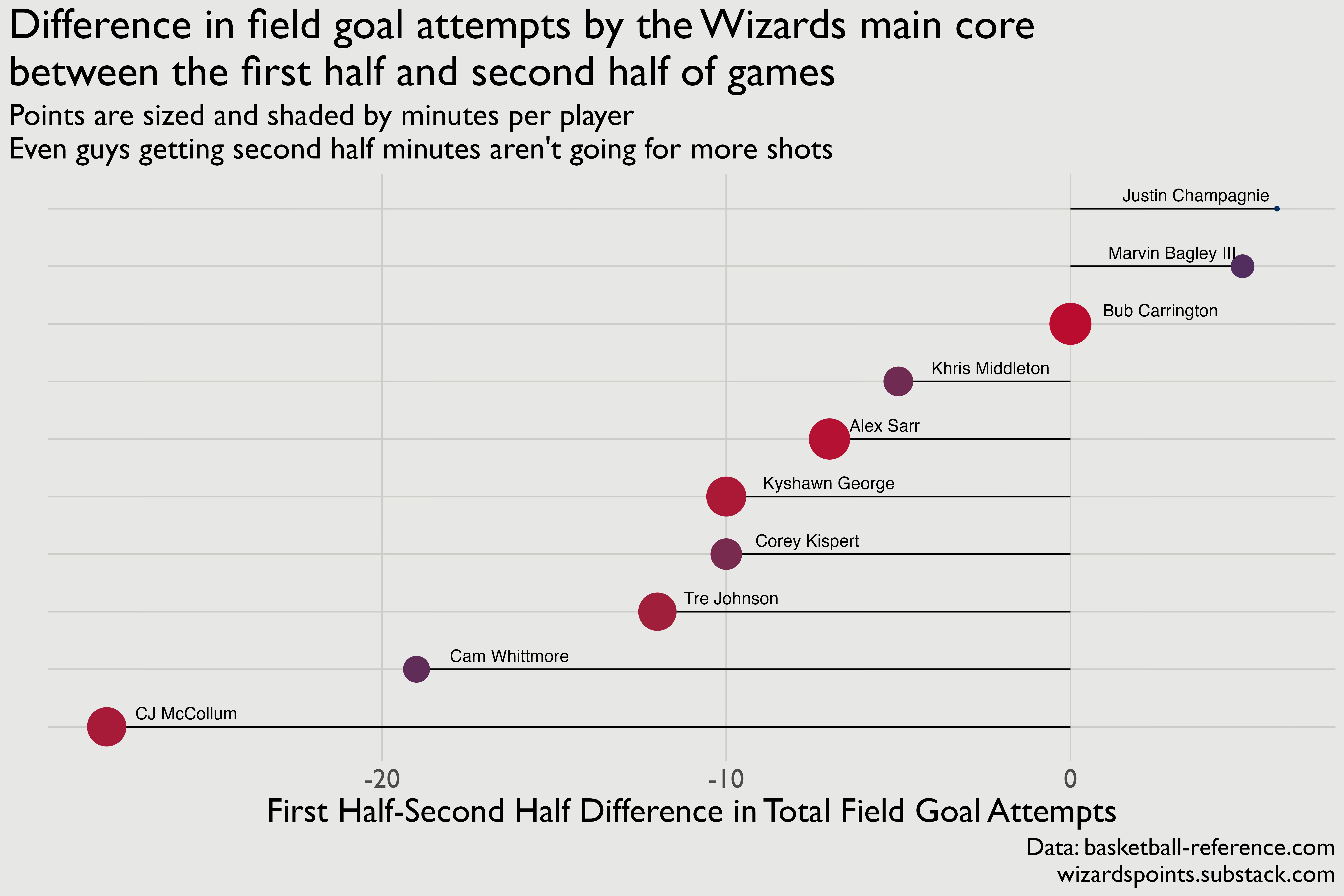
It is a bummer that if Sarr or Kyshawn progress at a rate even faster than they have (this is unlikely, but bear with me), they will need to be taken out of games or simply further set up to fail. Under normal rebuilding circumstances, a team would start figuring out how to get better, to really start building around their promising talent. For the Wizards, if they start flying even slightly toward the sun, their wings will need to get clipped because the upside of the pick is too high. We are year two of the rebuild—a rebuild that was necessary and is proving painful, but at times it feels like the line between tanking and kayfabe gets a little blurry.
The challenge watching this year’s Wizards is that show flashes, but they truly can’t make a leap or even a small hop developmentally. This cognitive dissonance puts the whole season into a nihilistic tailspin. You don’t want to ask yourself what the point of this is—if any of this really matters—while watching basketball because on some level it doesn’t matter. The players and their amazing athletic feats bring meaning to it, we create meaning through the viewing experience and connection to those players. People buy gear because of a connection to the guys on the court. No one wants a City Edition jersey with the name “Below-Apron” on it.
But progress is for next year’s team. And sure, we were hoping for the first round last year, but next year, we’re due. It’s not that there is a point shaving conspiracy going on, the plan is out in the open and for all to see. Tre Johnson and Alex Sarr are worth watching. Kyshawn George’s growth seems real. Bilal Coulibaly still hasn’t had a full showing. These are all reasons to tune it. But the decision of where that growth leads was made for these guys, at least for this season, years ago.
For this post, I’m just focused on the guys in the main two line ups so far this season. First unit players (Sarr, Carrington, George, Middleton, McCollum), who have been together for six games across 71 minutes and 155 possessions, and what I’m calling second unit players (Bagley, Kispert, Whitmore, George, Johnson), who have been together in five games across 39 minutes and 84 possessions. I’ve thrown in Champagnie since all of the line-ups that have been used consistently are basically the first and second units I just mentioned with Bilal making a couple of cameos and he’s sort of the next man up. We’re still early in the season, so I don’t want to say too much about, say, Will Riley, who gets about six minutes on average in fourth quarters but not much more than that.
Chief Keefe is one helluva tank commander! Did you see the game where we fouled down three with 32ish seconds remaining? (I'm also retroactively furious that he didn't play Ryan Rollins more. Watching Rollins and Deni ball out has been excruciating.)
Would love for the Wiz to hire JVG and sign Quentin Grimes next summer.
Will the codes for these visuals be up on the github? Great article, thanks